Flagfall strategy: how to find the Banner and keep yours
Flagfall strategy for Stratego fans: where to hide your Banner, how to scout with Hares, when to send Moles at Snares and how the Wisp beats the Bear.
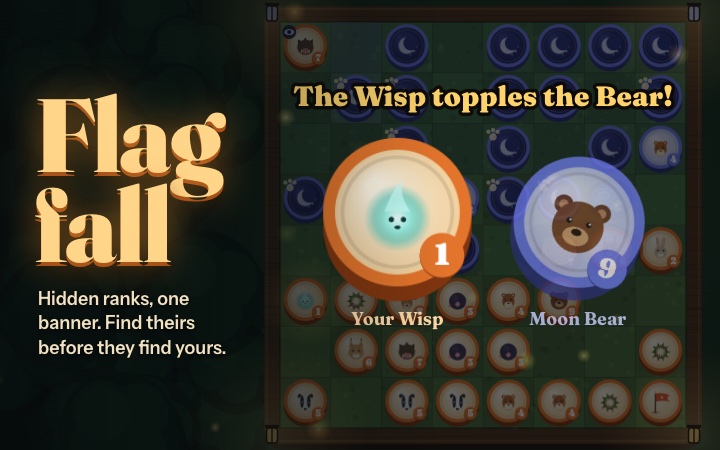
Flagfall is a hidden-rank board game in the same family as Stratego: you win by taking the enemy Banner before they find yours. A winning plan comes down to four habits: hide well, scout with cheap pieces, attack only what you can read, and keep your strongest pieces away from traps. Here is how each one works.
Know the army
Both sides have the same 24 pieces, set out in the back three rows of an eight-by-eight board. When two pieces fight, both are shown, the higher rank wins and equal ranks both fall.
| Piece | Rank | How many | What to know |
|---|---|---|---|
| Bear | 9 | 1 | The strongest. Only a Snare, or a Wisp that attacks it, can stop it. |
| Stag | 8 | 1 | Beats ranks 1 to 7. |
| Boar | 7 | 2 | Beats ranks 1 to 6. |
| Lynx | 6 | 2 | Beats ranks 1 to 5. |
| Badger | 5 | 3 | Beats ranks 1 to 4. |
| Stoat | 4 | 3 | Beats ranks 1 to 3. |
| Mole | 3 | 3 | Digs out Snares. |
| Hare | 2 | 4 | Runs any distance in a straight line. |
| Wisp | 1 | 1 | Loses to everything, but beats the Bear when the Wisp attacks. |
| Snare | none | 3 | Never moves. Catches any attacker except a Mole. |
| Banner | none | 1 | Never moves. If it is taken, the match is lost. |
Two stumps and two ponds sit in the middle of the board and block the way. The counts beside the board show how many of each piece both sides have left, so glance at them after every clash.
Hiding your Banner
On the setup screen, tap two of your pieces to swap them, or tap Shuffle for a new arrangement. A few ideas help:
- Tuck the Banner away from the front. Any attacker then has to get through other pieces first.
- Don't build an obvious fortress. Three Snares around one square tell a careful opponent exactly where to send a Mole. Put one Snare somewhere else as a decoy.
- Leave some pieces unmoved. Enemy pieces marked with paw prints have moved, so they cannot be a Snare or the Banner. The same rule works against you: every piece you have moved is crossed off the list of places your Banner could be. A few unmoved pieces spread around the board keep the other side guessing.
Scouting with Hares
You have four Hares, and they are your cheapest way to learn things. A Hare runs any distance in a straight line over empty ground and can attack at the end of the run. A Hare that runs more than one square shows its face, so a long run gives it away. A single step does not.
Send a Hare into an unknown piece and both pieces are shown. Pieces that have fought stay face up, so even a losing Hare tells you what you face. If it walks into a Snare, you have found a Snare, which is exactly what your Moles need.
Moles and Snares
Any attacker that walks into a Snare is caught, except a Mole, which digs the Snare out. You have three Moles, and the other side has three Snares, so don't spend Moles early on fights they cannot win. A Mole is only rank 3, and a Stoat or anything stronger beats it.
Once a Snare has caught something, it is face up. That is the moment to walk a Mole over, ideally with a stronger piece nearby.
Using the Bear, the Stag and the Wisp
Here is the most useful rule in the game. A piece with paw prints cannot be a Snare. So when your Bear attacks a piece that has moved, it either wins or, if that piece is their Bear, both fall. Your Stag is nearly as safe: against a moved piece it only loses to the Bear.
The Bear's real danger is the enemy Wisp. Once your Bear has fought, it stays face up, and the Wisp knows where to go. The Wisp only wins when it is the one attacking. If an unknown piece starts creeping toward your revealed Bear, strike it first: a Bear that attacks a Wisp wins.
Your own Wisp works the same way in reverse. Keep it hidden until the enemy Bear shows its face, then bring it close and attack.
Reading the computer
You can play against three computer levels: Sprout, Ranger and Elder. On Ranger and Elder the computer sometimes bluffs: it marches a small piece you have not seen toward one of your known middle-rank pieces, as if it could win. Don't pull back from every unknown piece that comes at you. If it has paw prints and your piece is strong, test it.
The Daily Skirmish is the same Moonwood army, playing the same way, for everyone today. The title screen shows how many moves your win or loss took, which makes it easy to compare with friends.
Long games and draws
You also win if the other side has no piece left that can move. When the Banner is well hidden, wearing down their moving pieces is a real path to victory.
Two rules stop stalling. A piece cannot shuttle between the same two squares more than three moves in a row, and after 60 turns each with no battle the match is a draw. If you are ahead on the piece counts, keep forcing fights so a lead doesn't fade into a draw.
Our games like Stratego page has more on the hidden-rank family.
Ready to put this into practice? Play Flagfall free in your browser.