Guess the year game tips: how to place history on the timeline
Guess the year game tips: place each event in its era, anchor on dates you know, read clues inside the clue, and score higher in Yesteryear every day.
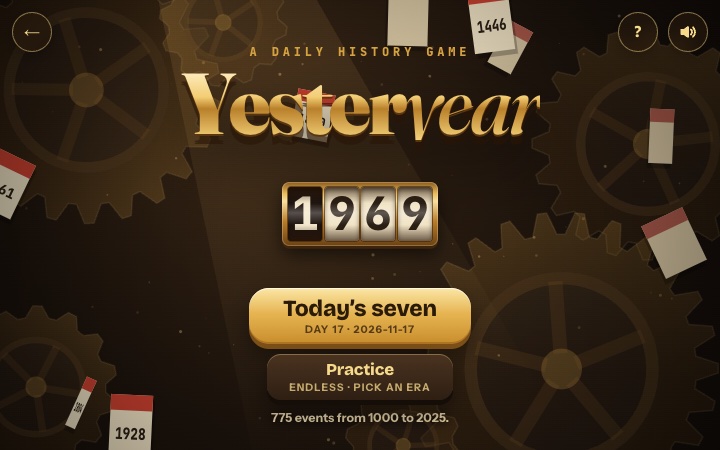
You get better at guess-the-year games by working from the outside in. First place an event in the right era, then measure it against a date you know for sure, then nudge. Close guesses score well, so a careful "about right" beats a wild stab at the exact year. Here is how that works in Yesteryear, our daily history game.
How Yesteryear scores
Each day brings seven events from history, the same seven for everyone, all between 1000 and 2025. You wind a brass measuring tape to the year you think each one happened. Each event is worth up to 100 points, so a perfect day is 700.
| Years off | Points |
|---|---|
| 0 | 100 |
| 2 | 97 |
| 5 | 92 |
| 10 | 84 |
| 25 | 63 |
| 50 | 33 |
| 100 or more | 0 |
Two things stand out. Being 10 years off still keeps most of the points, so don't panic about the exact year. And the first few years off cost the most, so moving a guess from 15 years off to 5 is worth more than moving one from 60 to 50. Effort spent on events you nearly know pays off best.
After each guess you see how close you came, with a verdict from "Bullseye" through "So close", "Close", "Right era" and "Off course" to "Lost in time", plus a fact about the event.
The seven are spread across history
Yesteryear builds each daily set with one event from each of seven spans of time: 1000 to 1499, 1500 to 1699, the 1700s, the 1800s, 1900 to 1949, 1950 to 1989, and 1990 to 2025. They are then shuffled. So if you are sure two events both feel like the 1800s, one of them probably belongs somewhere else. Look again at the one you are less sure of.
Start with the era
Before you think about a year, ask which era the event belongs to. Yesteryear's era strip, above the tape, marks them out:
- Medieval: 1000 to 1450
- Renaissance: 1450 to 1650
- Enlightenment: 1650 to 1789
- Industrial: 1789 to 1914
- World wars: 1914 to 1991
- Digital: 1991 onward
Tap the era strip to jump straight there, then fine-tune on the tape. As you wind, the counter also shows the era name for the year you are on, which is a handy check.
Anchor on dates you know
Keep a short ladder of dates you are certain of, and measure every event against the nearest one. A good starter set:
| Year | Event |
|---|---|
| 1066 | Battle of Hastings |
| 1215 | Magna Carta is sealed |
| 1492 | Columbus first crosses the Atlantic |
| 1776 | United States Declaration of Independence |
| 1789 | Storming of the Bastille |
| 1859 | Darwin publishes On the Origin of Species |
| 1903 | The Wright brothers' first powered flight |
| 1912 | The Titanic sinks |
| 1914 to 1918 | First World War |
| 1939 to 1945 | Second World War |
| 1969 | First Moon landing |
| 1989 | The Berlin Wall falls |
Then ask one question: was this before or after my anchor, and by roughly how much? "A bit after the Titanic" is already a strong guess.
Read the clues inside the clue
The wording of an event often narrows it down more than the event itself.
- Technology. Anything involving powered flight comes after 1903. Anything involving a telephone comes after Bell's patent in 1876.
- People. If you know roughly when someone lived, the event has to fall inside that life. A person's whole career is often a window of 30 or 40 years.
- Firsts and lasts. A "first" usually sits early in a technology's story, and the follow-ups come later.
- Names of places and countries. Names change over time, and the name used can hint at the period.
Use the controls well
Drag the tape to wind the counter, flick it to spin through the centuries, or tap a spot on the tape to move there. On a keyboard, the left and right arrows move one year, holding Shift moves ten, and Page Up and Page Down move a hundred. Enter locks your guess and goes to the next event. A good rhythm is: jump to the era, Page Up or Down to the right century, Shift and the arrows to the decade, then single years.
Practice and streaks
Today's seven change at midnight US Eastern time, and playing every day keeps your streak going. Practice is endless and lets you pick an era or a theme. Packs include "Castles & crusades", "Steam & telegraph", "Living memory", "Science & invention" and "Sport & culture". Spend a few rounds on whichever era you score worst in, and read the facts after each guess. That is how your ladder of anchors grows.
If you play other history guessing games, our games like Eraly page is about this family.
Grab the tape and play Yesteryear free in your browser.